
The Rise of Autonomous Agents in 2025 explores practical patterns, platforms, and governance conside...
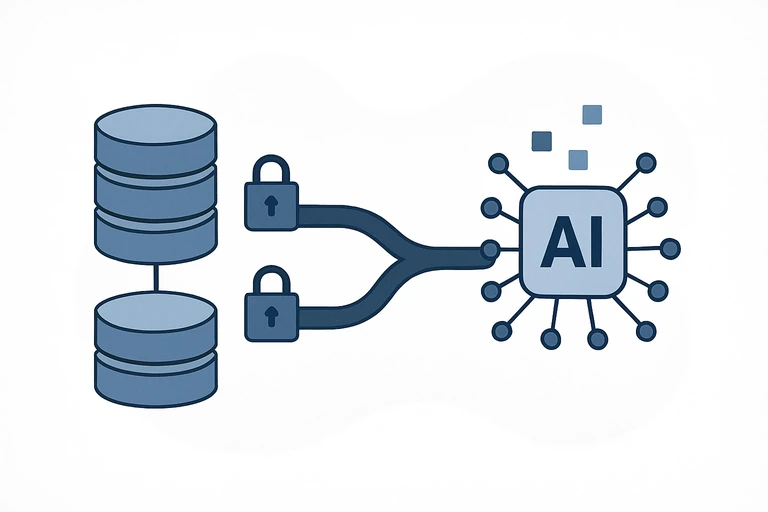
How to Train AI Models Using Your Company's Internal Data
A practical, end-to-end guide for training AI models with your company’s internal data. Learn how to plan, prepare, train, and deploy with governance, privacy, and measurable business impact.
Internal data can be a powerful fuel for AI, enabling models that understand your business context, customers, and operations better than anything sourced from public datasets. But training AI models with company data requires careful planning around data governance, privacy, quality, and deployment. This guide provides a practical, end-to-end approach you can adopt to train effective AI models using your organization’s internal data, with a focus on security, compliance, and measurable business impact.
Introduction
From customer support automation to predictive maintenance, internal data can unlock tailored AI solutions that directly address your most pressing business needs. However, success depends on: (1) clearly defined objectives, (2) trustworthy data pipelines, (3) appropriate model selection and training strategies, and (4) robust deployment and monitoring. This article outlines a structured roadmap you can follow, with concrete steps, guardrails, and best practices to minimize risk and maximize value.
1) Define objectives and success metrics
Begin with a business-driven lens. What problem are you trying to solve, and how will you measure success?
- Identify use cases: e.g., automate ticket triage, detect anomalies in manufacturing data, personalize marketing responses, forecast demand, or improve fraud detection.
- Specify success criteria: response time reduction, accuracy thresholds, uplift in conversion rates, or cost savings. Tie metrics to business KPIs (e.g., 15% faster ticket routing, 95% uptime).
- Define data requirements: which data sources, features, and labels are needed? what is the minimum viable dataset?
- Set governance constraints: privacy, security, and compliance requirements that the model must satisfy.
Document these outcomes in a lightweight model charter. It will serve as the north star for data collection, labeling, model selection, and evaluation.
2) Establish data governance and privacy baseline
Your data governance foundation determines model reliability and trust. Consider these pillars:
- Data classification and sensitivity: label data by sensitivity (public, internal, confidential, regulated). Apply least-privilege access controls.
- Retention and minimization: only train on data necessary to achieve the objective; define retention periods for raw and processed data.
- Privacy and compliance: align with applicable laws and standards (e.g., CCPA/CPRA, HIPAA if healthcare data, GDPR considerations for international data). Plan for data anonymization or pseudonymization where feasible.
- Data provenance and lineage: maintain traceability of data from source to model input, so you can audit, reproduce, and debug.
- Security controls: encryption at rest and in transit, secure data environments (VPCs, private networking), and robust authentication/authorization for data access.
- Ethics and bias mitigation: establish guardrails to monitor for biased outcomes and unfair impact on protected groups.
In practice, create a data access matrix, a data catalog, and standard operating procedures (SOPs) for data handling, labeling, and data quality checks. Multek can help design governance frameworks that balance speed with security and compliance.
3) Get data ready: discovery, collection, labeling, and quality
High-quality data is the engine of a successful AI model. Follow a structured data readiness process:
- Data discovery and inventory: map data sources (CRM, ERP, support tickets, logs, sensor data, etc.), understand data schemas, and identify data owners. Create a live data catalog with data quality attributes.
- Data extraction and normalization: standardize formats, unify timestamps, handle time zones, and normalize units. Address missing values transparently (imputation vs. exclusion).
- Data cleaning and deduplication: remove duplicates, correct errors, and resolve inconsistencies that could bias the model.
- Labeling and ground truth: define labeling guidelines, create labeling workflows, and establish a quality gate for labeled data. Use active learning to prioritize the most informative samples.
- Privacy-preserving prep: apply data masking or synthetic data where needed to protect sensitive information without sacrificing model usefulness.
- Data quality metrics: track completeness, consistency, accuracy, timeliness, and noise levels. Establish acceptance thresholds before model training.
Tip: start with a pilot dataset that represents the target use case, then progressively expand as you validate the pipeline. Synthetic data generation can help augment scarce labeled data while preserving privacy.
4) Training strategy and model selection
Choosing the right training approach depends on data size, domain specificity, and business constraints. Consider the following:
- Baseline models and transfer learning: start with proven pre-trained models (e.g., transformer-based models for text or tabular models for structured data) and fine-tune on your internal data. This typically requires less data and compute than training from scratch.
- Fine-tuning vs. training from scratch: for many enterprise use cases, fine-tuning a pre-trained model with domain-specific data yields faster time-to-value and better generalization.
- Domain adaptation and feature engineering: craft features that capture your business context (seasonality, product lines, customer segments) and experiment with feature interactions.
- Data leakage risk mitigation: ensure that leakage between training/validation/test splits is prevented (e.g., time-based splits for sequential data, proper cross-validation strategies).
- Model evaluation plan: define evaluation metrics aligned with business goals (precision/recall, F1, AUC, BLEU/ROUGE for text, MAE/RMSE for regression) and create robust holdout sets that reflect real-world scenarios.
- Regulatory and policy considerations: verify that the model’s outputs comply with internal policies and external regulations, especially for customer data and financial information.
Practical pattern: adopt a tiered training plan—start with a small, fast-running model to prove the concept, then scale to more complex architectures as data grows and governance matures.
5) Infrastructure, security, and MLOps for private data
Private AI requires a secure, scalable, and auditable environment. Key considerations:
- Deployment model: decide between cloud-hosted, on-premises, or a hybrid approach. For sensitive data, private cloud or on-prem solutions with strong encryption and access controls are common.
- Data isolation and inference: ensure data never unnecessarily leaves protected environments. Use private endpoints, VPCs, and secure inference servers. Consider techniques like confidential computing for additional protection.
- Data pipelines and orchestration: use reliable ETL/ELT pipelines and data catalogs. Automate data validation, lineage tracking, and model retraining triggers.
- ML tooling and observability: adopt platforms that support versioning of data, code, and models; monitor drift, performance, and resource usage; establish rollback plans.
- Cost and compute management: balance compute needs with cost controls. Use spot/preemptible instances where feasible and keep model sizes aligned with latency requirements.
- Security and access controls: enforce least-privilege access, MFA, and audit logging. Use secret management and key rotation for credentials used by data pipelines.
Tip: treat ML infrastructure as code. Version the configuration of data schemas, feature stores, model hyperparameters, and deployment manifests to ensure reproducibility and auditability.
6) Evaluation, deployment, monitoring, and continuous improvement
Measurement and governance don’t end at training. The model must perform in production and adapt over time:
- Robust evaluation: use holdout sets that reflect real usage, conduct back-testing, and measure business KPIs alongside traditional ML metrics.
- Deployment guardrails: implement safe defaults, confidence thresholds, and fallback behaviours for uncertain predictions. Include human-in-the-loop options when appropriate.
- Monitoring and drift detection: continuously monitor performance, data distributions, and user feedback. Set up alerting for significant drift or degradation.
- Retraining strategy: establish criteria and schedules for retraining with fresh data. Automate parts of the retraining pipeline while preserving governance checks.
- Bias, fairness, and safety checks: run periodic bias audits, calibrate outputs, and adjust thresholds to minimize unintended impact.
- Lifecycle management: track model versions, data lineage, and decisions to ensure compliance and reproducibility.
A successful deployment is not just a technical achievement; it’s a business capability. Plan for change management, user adoption, and ongoing collaboration with stakeholders from product, security, privacy, and legal teams. Multek can help design and implement end-to-end MLOps pipelines that embed governance into every stage of the model lifecycle.
Practical templates and exercises you can start today
data sources, owners, sensitivity, quality metrics, and access controls. Validate prerequisites before training begins. - Model Charter: a one-page document outlining objective, success metrics, data sources, privacy considerations, deployment plan, and governance requirements.
- Pilot Plan: a small, time-bound pilot with clear success criteria to demonstrate value and refine the data pipeline.
- Evaluation Protocol: a standardized set of metrics, data splits, and reporting templates to compare models fairly.
These artifacts help ensure alignment across teams and accelerate responsible AI delivery.
Conclusion and next steps
Training AI models with your internal data can unlock powerful, context-aware capabilities that drive real business results. The path requires careful planning: establish governance, prepare high-quality data, choose the right training strategy, build secure infrastructure, and implement robust evaluation and deployment processes. By following the framework above, you reduce risk, increase transparency, and maximize the likelihood of a successful AI initiative.
If you’re considering a private AI initiative or want help building a secure, scalable pipeline that respects data privacy while delivering measurable business value, Multek can help. Our team partners with you to design data governance, select the right models, implement compliant and efficient ML pipelines, and monitor performance in production.
You may also like

DevOps is within reach for SMEs. This practical guide outlines a lean, value-driven approach to auto...

Protecting APIs from leaks requires a defense-in-depth approach: strong authentication, fine-grained...