
The Rise of Autonomous Agents in 2025 explores practical patterns, platforms, and governance conside...
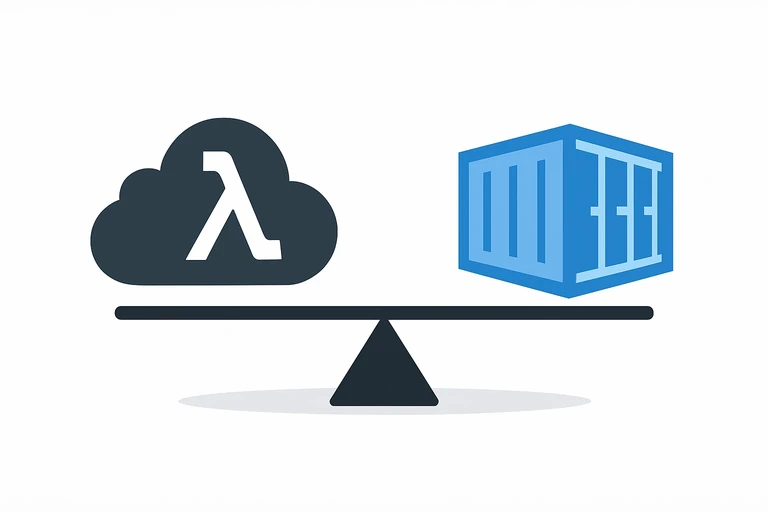
Serverless vs Containers: When to Use Each Approach
A practical guide to serverless vs containers, with a decision framework, use-case mapping, and hybrid patterns to help teams choose the right compute model for their workloads.
Introduction
Choosing the right compute model is one of the most consequential architectural decisions for modern software teams. On one hand, serverless platforms promise simplicity, automated scaling, and a pay-per-use cost model; on the other, containers offer portability, control, and flexibility for complex, long-running, or highly customized workloads. In this post, we’ll demystify serverless and containers, compare their strengths and trade-offs, and provide a practical decision framework to help your team decide when to use each approach—or a thoughtful mix of both.
What are Serverless and Containers?
Serverless refers to a class of cloud services where you don’t manage the underlying servers. You deploy small, stateless functions or use fully managed services, and the platform handles provisioning, scaling, and maintenance. Common flavors include Function-as-a-Service (FaaS) and other event-driven, managed compute options. Characteristics often cited for serverless:
- Automatic horizontal scaling with near-zero upfront capacity planning
- Pay-per-use pricing based on executions, duration, and resources
- Event-driven workflows (webhooks, queues, schedule-based jobs)
- Limited control over runtime, environment, and dependencies; faster time-to-market for MVPs
Containers encapsulate an application and its dependencies in a portable unit that runs anywhere with a container runtime. They give you more control over the runtime environment, lifecycle, and orchestration. Key traits:
- Consistent environments from development to production
- Support for complex, multi-service applications with multiple containers
- Flexible runtimes and dependency management; easier to test locally
- Typically managed through orchestration systems (e.g., Kubernetes, ECS, Nomad)
In practice, serverless and containers aren’t mutually exclusive. Many teams run serverless components alongside containerized microservices, and advanced patterns use serverless capabilities on top of containerized platforms (e.g., Knative or KEDA on Kubernetes). The goal is to leverage the strengths of each approach where they fit best.
Decision Framework: A Practical Model
To decide between serverless and containers, use a simple, repeatable framework built around workload characteristics and organizational priorities. Start with these criteria:
- execution duration: Are tasks short-lived (seconds to minutes) or long-running (hours or more)?
- traffic patterns: Is traffic highly irregular or predictably steady?
- statefulness: Do tasks rely on persistent connections, in-memory state, or large in-memory caches?
- control and customization: Do you need specific runtimes, libraries, or kernel features?
- compliance and security: Are there strict data residency, audit, or governance requirements?
- cost model: Is predictable spend important, or is pay-per-use acceptable even if it fluctuates?
- developer experience: How important is local development parity and debugging flexibility?
Next, translate these criteria into a practical mapping. A common heuristic is to think in terms of “stateless, event-driven, and rapid scale” vs “stateful, predictable performance, and deeper control.” If you’re torn, consider a hybrid approach that hybridizes serverless components with containerized services.
When to Choose Serverless
Serverless shines in scenarios that benefit from rapid iteration, low operational burden, and elastic scale. Consider serverless for:
- Event-driven workloads: Webhooks, real-time event processing, media transcoding triggers, or data processing pipelines driven by queues.
- Unpredictable or bursty traffic: Startups or features with sudden traffic spikes where capacity planning is hard.
- MVPs and rapid experimentation: You want to deliver value quickly without managing infrastructure.
- Lightweight stateless API endpoints: Simple APIs that can be implemented as small, independent functions.
- Time-to-value and cost efficiency in scale: When workloads are sporadic and the provider’s pricing model aligns with usage patterns.
- Managed service integration: Use of integrated cloud services (databases, queues, analytics) with minimal boilerplate code.
Common caveats to be aware of with serverless:
- Cold starts can introduce latency for certain runtimes or languages.
- Vendor lock-in risk increases when relying on provider-specific features and event sources.
- Limited control over the runtime, file system, and long-running processes.
- Debugging and local development parity can be more challenging; emulate the cloud as closely as possible.
When your primary needs are speed, scale on demand, and minimal ops, serverless is often the quickest path to value. It’s particularly effective for webhook handlers, light API layers, or lightweight data-processing tasks that can be decomposed into stateless functions.
When to Choose Containers
Containers excel when control, performance, and portability matter. Consider containers for:
- Long-running services: APIs, background workers, streaming services that run continuously.
- Complex, multi-container applications: Microservices that require tight coordination, sidecars, or custom networking.
- Custom runtimes and dependencies: You need specific OS libraries, kernels, or runtime versions not supported by serverless.
- Strict compliance and governance: Environments with auditable build pipelines, image provenance, and reproducible deployments.
- Hybrid or on-prem deployments: Data residency, network latency, or security constraints favoring control over where code runs.
- Portability and vendor-agnostic architectures: You want to avoid cloud vendor lock-in by using standard container runtimes across environments.
Important considerations when opting for containers:
- Operational burden: You’re now responsible for orchestration, scaling policies, and cluster health.
- Resource planning: You’ll need capacity planning for CPU, memory, and storage, and potentially more sophisticated autoscaling (e.g., Kubernetes HPA, vertical scaling).
- Observability: Requires instrumentation across logs, metrics, traces, and distributed tracing to understand complex systems.
- Security hygiene: Image scanning, dependency management, and secure cluster configurations become critical.
Containers are often the right choice for production-grade APIs, data-intensive services, or workloads that demand consistent performance and full control over the runtime. They also pair well with mature CI/CD pipelines, private registries, and hybrid cloud strategies.
Hybrid and Multi-Cloud Patterns: Making the Most of Both Worlds
Many teams adopt a hybrid approach that leverages the strengths of serverless for event-driven tasks and containers for core services. Practical patterns include:
- API layer in containers, event processing in serverless: Core business logic runs in containers; background jobs or webhook handlers run as serverless functions to scale automatically with traffic.
- Knative or serverless containers on Kubernetes: Use Knative to run serverless workloads on your Kubernetes cluster, combining container portability with serverless autoscaling.
- KEDA-enabled scaling: Event-driven scaling policies for containers based on queue length, HTTP requests, or custom metrics.
- Hybrid data strategies: Sensitive data remains in on-premises or private clouds while non-sensitive, bursty workloads run serverlessly in the public cloud.
These patterns require thoughtful governance—clear ownership, cost controls, and robust monitoring. The goal is to reduce operational risk while delivering fast, reliable software with predictable SLAs.
Practical Steps to Decide: A Step-by-Step Guide
- Inventory your workloads: List all services and tasks. Classify them as stateless vs stateful, short-lived vs long-running, and incident-driven vs steady-state.
- Map to deployment patterns: Sketch which components could live in serverless and which belong in containers. Identify potential boundaries for each workload.
- Pilot small, representative workloads: Convert a lightweight, event-driven function and a small containerized service into a pilot. Monitor latency, cost, and operability.
- Build a cost and performance model: Compare TCO for serverless vs containers across expected load scenarios. Include cold-start effects, data transfer, and storage.
- Define governance and security controls: Establish identity, access management, and policy enforcement across both platforms. Plan for secret management, image scanning, and audit trails.
- Establish observability and SLAs: Ensure unified logging, tracing, and metrics across serverless and containerized components. Agree on SLOs and SLI dashboards.
- Decide on a staged migration / hybrid pattern: If your workloads evolve, design with modular boundaries so you can shift components between serverless and containers as needed.
Cost, Security, Observability, and Risk
Cost
Serverless often lowers upfront costs and eliminates idle capacity, but it can lead to unpredictable invoicing for high-throughput or long-running tasks. Containers provide predictable costs when you own the cluster and capacity, but require investment in orchestration, cluster management, and capacity planning. A practical approach is to model both scenarios for your real workload mix and monitor actual spend over a few weeks after a deployment, then adjust.
Security
Security considerations differ but are crucial in both paradigms. For serverless, focus on function-level IAM permissions, strict event source access, and minimal function dependencies. For containers, emphasize image provenance, regular vulnerability scanning, least-privilege Kubernetes RBAC, network segmentation, and secure secret management. Regular audits and compliance checks should span both environments.
Observability
Distributed tracing, centralized logging, and metrics collection are essential in either model. Serverless often benefits from vendor-provided tracing and integration with managed observability services. Containers may require more explicit instrumentation and a cohesive telemetry plan across services, pipelines, and data stores.
Risk and Governance
Hybrid architectures introduce complexity. Establish clear ownership (which team owns which services), cost governance (budgets and alerts), and deployment controls (feature flags, canaries, and rollback plans). A disciplined approach reduces risk when experimenting with new patterns.
Real-World Scenarios: Where Teams See the Trade-offs
Scenario A: A payment processor’s webhook handler spikes irregularly during promotional campaigns. Using serverless for the webhook processor and a small containerized microservice for the core API can deliver fast scaling with cost efficiency when traffic surges, while preserving a robust API surface in containers for reliability and debugging.
Scenario B: A data-intensive API with heavy dependencies and long startup times. A containerized setup (possibly on Kubernetes) gives you control over the runtime, libraries, and resource limits, making for predictable latency and easier integration with on-prem data stores.
Scenario C: A SaaS platform with a core API and multiple background jobs. Run the API in containers for stability, while offloading sporadic event processing and analytics to serverless functions to capitalize on elasticity and rapid iteration.
Conclusion
There isn’t a single, universal answer to whether serverless or containers are the right choice for every workload. The most effective strategy is to analyze workload characteristics, cost implications, security and governance needs, and your team’s capability to operate both platforms. For many teams, a pragmatic hybrid model—containerized core services with serverless components for event-driven tasks—offers the best of both worlds: control when it matters, and speed where it counts. As you plan, keep the end goals in mind: speed of delivery, reliability, security, and measurable business impact.
If you’d like a structured architecture review to map your workloads to the most effective combination of serverless and container-based deployments, Multek can help. Our team collaborates with you to design pragmatic, scalable solutions that balance speed, cost, and control while safeguarding security and privacy.
You may also like

DevOps is within reach for SMEs. This practical guide outlines a lean, value-driven approach to auto...

Protecting APIs from leaks requires a defense-in-depth approach: strong authentication, fine-grained...