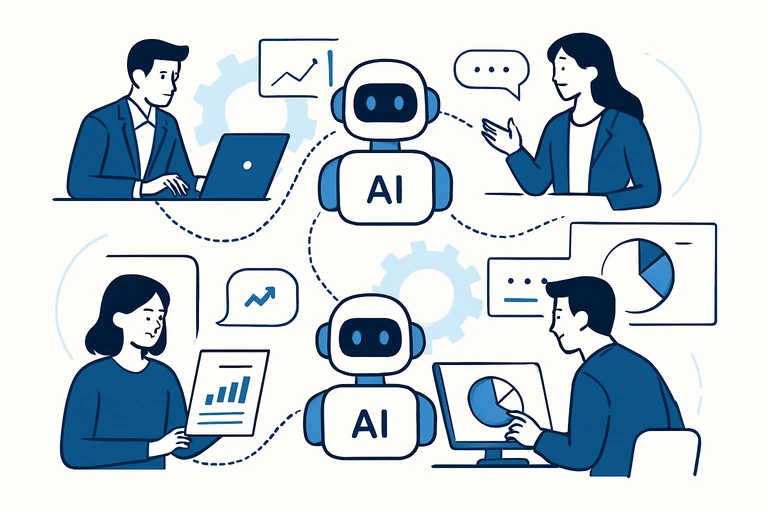
The Rise of Autonomous Agents in 2025 explores practical patterns, platforms, and governance conside...

Real Stories: Companies That Grew with Custom Software
Real-world stories show how tailored software can unlock growth: from digital commerce at Domino’s and scalable delivery at Airbnb to AI‑powered customer experiences at Starbucks and a resilient Netflix platform. Learn practical takeaways and a step‑by‑step playbook to apply these lessons to your business.
Real Stories: Companies That Grew with Custom Software
Discover how organizations across industries transformed their growth trajectories by investing in tailor-made software solutions. From e‑commerce dominance and scalable architectures to data-driven operations and AI-powered decision making, these stories illustrate practical paths for turning ideas into high‑impact products and services.
Introduction: Why custom software often unlocks faster growth than off‑the‑shelf solutions
When a business reimagines its processes, products, and customer interactions around software that is built to fit its unique needs, the payoff can be dramatic. Real-world stories show that the right software strategy – aligned with business goals, data, and user experience – can shorten time‑to‑value, improve margins, and enable new business models. The cases below illustrate common threads: a growth‑oriented product mindset, an architecture built for scale (often via microservices and automated delivery), data‑driven decision making, and a continual feedback loop between users and engineers. As a software partner, Multek helps teams design and build these kinds of tailor‑made solutions, combining product focus, agile execution, and AI where it adds measurable value.
Domino’s Pizza: digital‑first transformation that turned software into a growth engine
Domino’s began treating itself as an ecommerce company that happens to sell pizza. The result was a multi‑year digital transformation built on native apps, cross‑channel ordering, and high‑velocity experimentation. The shift toward digital channels was not incidental: it changed who the company was and where it could win. By focusing on a seamless ordering experience across devices and platforms, Domino’s moved from a partial to a dominant digital business model. The company’s digital momentum was underscored by strong revenue growth from online channels and a broad reach across devices and ecosystems, including voice, in‑car systems, and TV interfaces.
Key takeaways include: (1) framing the business around digital channels and customer journeys, (2) investing in a robust, device‑agnostic ordering platform (the Pizza Tracker and cross‑channel ordering), and (3) using data and experimentation to continuously optimize the user experience. These moves contributed to a sustained rise in digital sales and an improved competitive position.
- structural shift: from a traditional restaurant model to a technology‑driven commerce company.
- outcomes: multi‑device ordering, faster delivery, and data‑driven marketing and operations improvements.
For large-scale digital deployments, Domino’s collaboration with cloud providers and partners demonstrated how a high‑velocity software program can drive measurable business outcomes, including faster order processing and better customer insights.
Netflix: building resilience and scale with microservices and chaos engineering
Netflix’s growth story is as much about its software architecture as its content. Moving from a monolith toward a cloud‑native, microservices‑driven architecture enabled continuous deployment at scale and rapid experimentation. A hallmark of Netflix’s approach has been “chaos engineering” – deliberately injecting failures to uncover weaknesses and harden the system. The result is a platform capable of delivering a high‑quality streaming experience to hundreds of millions of users around the world, even as traffic patterns, regional outages, and new features are introduced.
Two concrete elements from Netflix’ playbook are (1) chaos engineering tools (the Simian Army, including Chaos Monkey) to test reliability in production and (2) an open source orchestration foundation (Conductor) used to coordinate long‑running workflows across many services. These strategies illustrate how tailored software practices can scale operations, reduce risk, and enable rapid growth.
- resilience: automated testing and fault tolerance baked into daily development and deployment.
- operations: orchestration tooling to manage complex workflows across hundreds of microservices.
Airbnb: from monolith to scalable service‑oriented delivery with automated, data‑driven operations
Airbnb’s engineering journey highlights the power of scalable software platforms to support rapid business growth. The shift from a monolithic architecture to a service‑oriented approach involved thousands of services and a strong emphasis on automated delivery pipelines. The team adopted Spinnaker and built internal tooling to streamline testing, deployment, and release risk management. Data dashboards and instrumentation were embedded to help service owners understand deployment frequency, rollback risk, and the impact of canary analyses. This combination of scalable architecture, automation, and data visibility enabled faster feature delivery and improved reliability as the company expanded globally.
Two standout aspects from Airbnb’s experience are (a) a migration strategy focused on safe, incremental adoption of new tooling and (b) a commitment to continuous delivery that increased deployment velocity while reducing incidents. The result was a more agile organization able to scale its platform to support millions of users and listings around the world.
Inditex (Zara): digitizing the supply chain to stay fast in a fast industry
Inditex’s Zara brand is frequently cited as a gold standard in fast fashion, and much of that achievement rests on a highly digitized supply chain. RFID‑driven visibility, real‑time data flows, and integrated design–production–distribution processes enable Zara to design, produce, and ship thousands of new designs with remarkable speed. Harvard Business School’s case on Inditex highlights how digitization supports demand forecasting, inventory accuracy, and rapid replenishment – allowing the company to maintain a relentless pace while controlling costs and waste. This case demonstrates how tailored software and data systems can unlock a competitive advantage in supply chain responsiveness.
- speed to shelf: designs and products cycle quickly to market based on real‑time data.
- visibility: RFID and integrated systems reduce waste and improve replenishment decisions.
Starbucks: turning a digital ecosystem into growth through rewards, ordering, and AI‑powered insights
Starbucks has consistently pursued a comprehensive digital ecosystem centered on its mobile app, loyalty program, and data‑driven customer experiences. The company’s digital flywheel includes mobile ordering, payment, and personalized offers, all enabled by a broad data strategy and a history of investing in UX and reliability. The result has been a sustained increase in digital engagement, loyalty, and revenue share from mobile channels. While recent operational headlines reflect a mixed year on stock and store performance, the core lesson remains: a well‑designed digital platform that integrates ordering, payments, loyalty, and AI‑assisted insights can dramatically amplify customer lifetime value when implemented with care for operational realities.
- loyalty engine: a robust rewards program that drives repeat purchases and richer customer data.
- AI & personalization: AI capabilities (e.g., Deep Brew concepts) help tailor offers and optimize store operations.
What these stories teach us about growing with tailor‑made software
Across these examples, several common patterns emerge that can guide any organization considering a tailored software strategy:
- Start with business goals, then design software around them: Each company aligned software capabilities with a clear value driver (growth in digital sales, resilience, speed to market, or customer engagement). This ensures the software initiative directly contributes to measurable outcomes.
- Invest in scalable, modular architectures: From microservices to automated delivery pipelines, scalable architectures enable teams to ship faster and with lower risk. Airbnb’s migration to SOA and Netflix’s microservices approach are classic examples.
- Embrace data and experimentation: Data dashboards, experimentation, and canary analyses reduce risk and accelerate learning, leading to better product decisions. Airbnb’s data‑driven delivery and Netflix’s continuous experimentation stance illustrate this well.
- Balance UX with operations: A great frontend experience must be matched with robust operational tooling (tracking, deployment, and monitoring) to sustain growth. Domino’s experience shows how good UX across devices must be paired with reliable, scalable backend services.
- Use AI carefully to augment decision making: AI initiatives can power personalization, automate routine tasks, and improve decision quality, but they should be designed with governance, privacy, and user trust in mind. Starbucks' AI‑enabled personalization and store optimization offer a useful reference.
Practical playbook: how to start growing with tailor‑made software
If you’re aiming to replicate this kind of growth, use this pragmatic, eight‑step playbook. It blends proven practices from the stories above with a clear path to execution in a typical mid‑market organization.
- Define a measurable growth objective. Identify a single, ambitious but achievable target (for example, increase digital orders by X% in 12 months, or reduce time‑to‑value for a key process by Y%). Tie this to a concrete metric (revenue, margin, retention, or user engagement).
- Map the value stream and identify bottlenecks. Diagram the end‑to‑end process from customer need to value delivered, and locate where software could unlock the most impact. Use value‑stream mapping or similar framework to pinpoint the highest ROI interventions.
- Design an MVP with a modular architecture. Start with a small, cross‑functional team and a service‑oriented or modular design. Prioritize a platform approach (APIs, data models, and a delivery pipeline) that can grow with you. Airbnb’s transition to a service‑oriented model and Domino’s cross‑channel architecture illustrate the power of a scalable foundation.
- Instrument data everywhere. Build analytics and telemetry into the MVP so you can measure usage, detect problems, and iterate quickly. Data dashboards for services and canary analysis are excellent patterns to adopt early.
- Adopt continuous delivery and automated testing. Move toward automated pipelines, canary releases, and rapid rollback capabilities to reduce risk as you scale. Airbnb’s deployment tooling and Spinnaker adoption provide a concrete blueprint.
- Focus on security, privacy, and ethics from day one. Build privacy controls, data governance, and security testing into your development lifecycle. Real‑world growth stories show that security and reliability are enablers of trust and scale.
- Iterate, learn, and scale with AI as an accelerator. Use AI to automate repetitive tasks, personalize experiences, and augment decision making, but implement guardrails and governance. Starbucks’ data and AI‑driven personalization is a practical reference.
- Choose the right partner for tailored software, if needed. A pragmatic collaboration can accelerate discovery, design, and delivery of a platform that fits your business, culture, and budget constraints. The stories above illustrate how the right software strategy compounds value across product, operations, and customer experience.
Conclusion: tailor‑made software as a driver of durable growth
The journeys of Domino’s, Netflix, Airbnb, Inditex, and Starbucks show something consistent: when software is built around a company’s unique goals, processes, and people, it becomes a true growth engine. Whether you’re streamlining ordering, delivering resilience at scale, improving delivery and pickup experiences, or enabling a data‑driven supply chain, the core pattern is the same: a business‑first software strategy that embraces agile execution, scalable architecture, and continuous learning. At Multek, we help teams translate ambitious ideas into practical, high‑impact software programs – delivered quickly, safely, and ethically – so you can compete with larger players without the burden of traditional vendor relationships.
You may also like

DevOps is within reach for SMEs. This practical guide outlines a lean, value-driven approach to auto...

Protecting APIs from leaks requires a defense-in-depth approach: strong authentication, fine-grained...