
The Rise of Autonomous Agents in 2025 explores practical patterns, platforms, and governance conside...
Multi-Cloud vs Single Cloud: Advantages and Risks
A practical guide to choosing between multi-cloud and single-cloud strategies. Learn the advantages, risks, decision frameworks, and actionable steps to design resilient, cost-effective cloud architectures.
The cloud landscape continues to evolve, and so do the decisions about where and how to run applications and store data. For most organizations, the choice isn’t simply “one cloud or many.” It’s about balancing flexibility, risk, cost, and speed to value. This guide breaks down the core concepts of multi-cloud and single-cloud strategies, highlights the advantages and risks of each, and offers a practical framework to help you design a cloud architecture that aligns with business goals and security requirements.
Understanding the core concepts
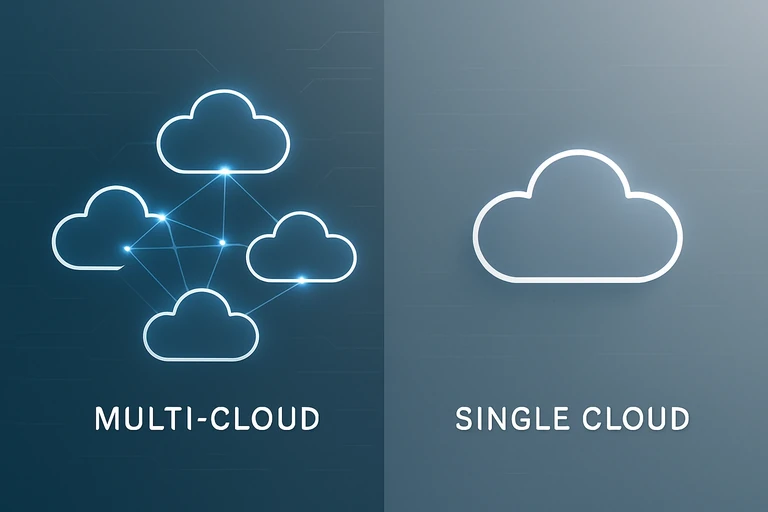
Single cloud refers to running the majority of an organization’s workloads on a single cloud provider. This can simplify design, governance, and operations, and often enables deeper service integration, faster time to market, and favorable pricing dynamics when you scale within that ecosystem.
Multi-cloud means deploying workloads and data across two or more cloud providers. This approach can be true multi-cloud (distributing workloads across multiple public clouds for resilience and optimization) or hybrid (combining public cloud with on‑premises or edge environments). The core idea is: don’t rely on a single provider for all capabilities.
Both strategies have their use cases. The optimal choice depends on workloads, regulatory constraints, cost models, internal capabilities, and the level of risk your organization is willing to assume.
Why organizations choose multi-cloud
- Diversification and resilience: Spreads risk across providers, reducing the impact of a single provider outage or service limitation.
- Best-of-breed services: Different clouds excel in different areas (e.g., AI/ML services, data analytics, networking). A multi-cloud approach lets you leverage the strongest offerings from each provider.
- Data sovereignty and compliance: Some workloads must reside in or transit through specific regions or providers to meet regulatory or contractual requirements.
- Vendor flexibility and negotiating power: With competition among providers, organizations can optimize pricing and terms.
Risks and challenges of multi-cloud
- Architectural complexity: Integrating services, data flows, and parallel security policies across clouds increases design and operational complexity.
- Security and compliance posture: Maintaining consistent security baselines and audits across multiple environments is harder and requires robust governance.
- Cost visibility and management: Inter-cloud data transfer fees, disparate pricing models, and fragmented cost reporting can obscure true total cost of ownership.
- Talent and skills fragmentation: Teams must maintain expertise across multiple platforms, increasing training needs and potential gaps in incident response.
- Data gravity and latency: Moving or syncing data across clouds can introduce latency and synchronization challenges, especially for real-time workloads.
Advantages of a single-cloud strategy
- Simplified operations: A unified control plane, consistent tooling, and shared security models simplify governance and automation.
- Deeper integration and performance: Native services often work best together, enabling faster development cycles and potentially lower latency for core workloads.
- Predictable cost and budgeting: With a single pricing ecosystem, cost tracking and optimization can be more straightforward, leveraging provider incentives and longer-term commitments.
- Faster time to value: Fewer cross-cloud integration points can speed up delivery and reduce friction for teams.
Risks and considerations of a single-cloud approach
- Vendor lock-in: Dependency on a single provider can complicate migrations, limit access to innovations, and expose you to price changes.
- Outage exposure: A regional or global cloud disruption can affect a large portion of the business if there’s no fallback plan.
- Regulatory and service gaps: The chosen provider may not meet every regulatory requirement or offer every service needed for a growing portfolio.
A practical decision framework
Use a structured approach to decide between multi-cloud and single-cloud, or to adopt a pragmatic hybrid strategy. The framework below helps translate business goals into architecture choices and actionable steps.
- Step 1 — Catalog workloads and requirements: For each workload, document latency sensitivity, data gravity, regulatory constraints, required services (AI, databases, analytics), and security/compliance needs.
- Step 2 — Define resilience and data strategy: Decide on recovery objectives (RPO/RTO), data replication needs, and whether DR should be cloud-native, cross-cloud, or on-prem.
- Step 3 — Assess risk tolerance and cost realities: Weigh the cost of data transfer, storage, and cross-cloud data movement against risk, speed, and feature benefits.
- Step 4 — Choose an architectural pattern: Primary cloud with regional DR, true multi-cloud with workload distribution, or a hybrid approach that preserves portability for critical systems.
- Step 5 — Build a lightweight governance model: Establish standards for IAM, network segmentation, logging, incident response, and cost governance that span providers.
- Step 6 — Pilot and iterate: Run small, bounded pilots to validate performance, security, and cost. Use the results to refine the design before broader rollout.
Tip: Create a simple scoring rubric for each workload on a 1–5 scale across latency, data gravity, security/compliance, cost, and portability. Weigh criteria by business priority and sum scores to guide the decision.
Architectural patterns and practical practices
1) Embrace portability with containerization and modern tooling
- Package workloads in containers and orchestrate with Kubernetes or a managed Kubernetes service available across clouds to improve portability.
- Use cloud-agnostic infrastructure as code (IaC) tools like Terraform or Pulumi to standardize resource definitions across providers.
2) Design data strategies for cross-cloud clarity
- Define data residency requirements and implement appropriate replication or federation patterns to meet latency and compliance needs.
- Separate compute from data where possible to minimize cross-cloud data movement. Use event-driven patterns and data streaming to sync only what’s necessary.
3) Unify identity, access, and security
- Adopt a centralized identity strategy (SSO + SCIM) to manage users consistently across clouds.
- Implement a baseline security framework (encryption at rest/in transit, key management, IAM governance, network controls) that is enforceable in every environment.
4) Achieve observability and cost visibility across clouds
- Use a unified observability stack (metrics, logs, traces) that can ingest data from multiple providers and present a single view for incident response.
- Tag resources consistently and implement cross-cloud cost dashboards to prevent budget overruns and improve accountability.
5) Plan for security, compliance, and governance
- Establish baseline controls (patch cadence, vulnerability management, access controls) that apply across all environments.
- Document compliance mappings (e.g., PCI, HIPAA, GDPR) and ensure control implementations are auditable across clouds.
Practical steps to implement a cloud strategy
- Discovery and portfolio assessment: Inventory your applications, data sets, and workloads. Identify dependencies, data flows, and regulatory constraints.
- Define the target model: Decide whether you’ll pursue true multi-cloud, a single-cloud with strong DR, or a hybrid approach with portable workloads.
- Prototype and pilot: Run small-scale pilots to validate capabilities, performance, and costs in the chosen model.
- Establish governance foundations: Create a cross-cloud policy framework, common CI/CD practices, and unified security baselines.
- Scale with phased migrations: Move workloads in waves, starting with non-critical or easily portable systems to minimize risk.
- Operate and optimize continuously: Continuously monitor performance, costs, and risk exposure; adjust architecture as business requirements evolve.
Common pitfalls to avoid include over-optimizing for a single feature at the expense of portability, underestimating data transfer costs, and building bespoke, cloud-specific automation that doesn’t travel well to other providers.
Real-world patterns (illustrative examples)
A financial services firm runs its core processing in one primary cloud for maximum efficiency and uses a secondary cloud only for disaster recovery and long-tail analytics. - Hybrid with portable workloads: A retailer keeps customer-facing services in one cloud where latency is critical and uses another cloud for batch analytics and AI workloads with data replicated on a scheduled basis.
- True multi-cloud for resilience: An online platform distributes microservices across two clouds to minimize the blast radius of outages and to leverage unique ML capabilities from each provider.
These patterns illustrate that you don’t have to go all-in on one model. A thoughtful mix can deliver resilience, cost efficiency, and access to best-of-breed services while staying aligned with business goals.
Multek perspective: pragmatic cloud decisions for speed and ethics
At Multek, we help organizations design cloud strategies that balance agility, cost, and security. Our approach emphasizes practical architectures, transparent governance, and measurable outcomes. Whether you’re weighing multi-cloud for risk diversification or pursuing a streamlined single-cloud approach for speed and simplicity, our teams assist with:
- Workload profiling and architecture decision support
- Cloud-agnostic tooling and IaC patterns for portability
- Bespoke security baselines, identity strategies, and compliance mappings
- Cross-cloud observability and cost governance
- Migration planning, risk assessment, and pilot programs
Our mission is to help you achieve the right balance between innovation, speed, and ethical considerations—security, privacy, and sustainability embedded in every decision.
Conclusion
Choosing between multi-cloud and single-cloud strategies is not a binary decision. It’s about aligning technology choices with business risk, cost, and speed to value. A well-planned multi-cloud setup can offer resilience and access to the best services, while a disciplined single-cloud approach can deliver simplicity, deeper integration, and faster delivery. The right path for your organization may also involve a hybrid pattern that combines portability, governance, and strategic partnerships across providers.
If you’re evaluating cloud architecture options, Multek can help you map workloads, design governance, and implement a scalable strategy that delivers tangible business outcomes. Reach out to discuss a tailored plan that fits your goals and budget.
You may also like

DevOps is within reach for SMEs. This practical guide outlines a lean, value-driven approach to auto...
Protecting APIs from leaks requires a defense-in-depth approach: strong authentication, fine-grained...