
The Rise of Autonomous Agents in 2025 explores practical patterns, platforms, and governance conside...
Microfrontends and Microservices: Trends for 2025
A practical guide to the 2025 trends in microfrontends and microservices, with patterns, tools, and a step-by-step adoption plan to help teams deliver faster while maintaining independence and security.
As of August 25, 2025, the software industry continues to converge frontend and backend patterns to empower autonomous teams, accelerate delivery, and improve user experiences. This post explores the latest trends in microfrontends and microservices, with practical guidance you can apply today.
Microfrontends and Microservices: Trends for 2025
Introduction: Why the convergence matters in 2025
Microservices have long defined how organizations structure backend systems: small, independently deployable services oriented around business capabilities. The frontend world has followed suit with microfrontends, treating the UI as a composition of autonomous, deployable pieces. This parallel evolution is not just a technical fad; it’s a response to growing product complexity, larger teams, and the need for faster, safer releases. In 2025, the trend is to unify autonomous teams with cohesive architectures that still preserve independence where it matters.
For context, experts define microservices as a collection of small, independently deployable services that communicate over lightweight protocols, typically HTTP-based APIs. They emphasize decentralized governance and data management, enabling teams to own a service end-to-end. Microfrontends extend this philosophy to the browser, enabling independent frontend pieces that can be built, tested, and deployed separately while composing into a single UI. Sources: Martin Fowler & ThoughtWorks
Section 1: Microfrontends in 2025 — what’s new and what to watch
Microfrontends (MFEs) remain a powerful pattern for scaling frontend teams and delivering modular user interfaces. In 2025, practitioners emphasize not only splitting the UI but also coordinating multiple independent deployments with robust orchestration and governance. Key ideas include:
- Module Federation and independent builds: Webpack's Module Federation enables separate frontend builds to expose and consume modules at runtime, effectively enabling MFE scenarios where hosts load remote components without rebuilding everything. This approach supports decoupled deployments and can dramatically reduce build times for large apps. (Webpack Module Federation docs)
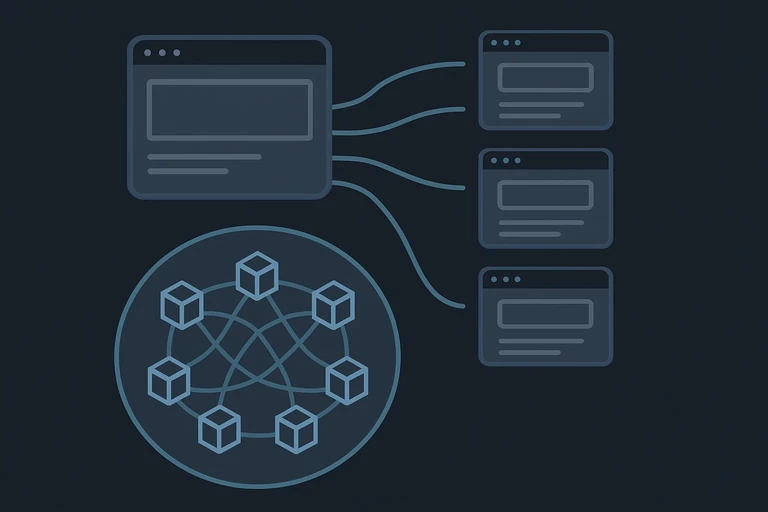
- Shell and remotes architecture: The canonical MFE pattern uses a shell (host) app and multiple remotes, each owning a feature or domain. This structure supports independent deployments and clearer ownership across teams. Framework-agnostic tooling like Module Federation and monorepo workflows (e.g., Nx) are popular for enabling this setup. (Nx MFEs overview)
- Framework parity and governance: While MFEs can mix frameworks, most teams aim for strategic consistency (e.g., same UI library or design system) to curb runtime surprises. Nx’s guidance on MFEs highlights the trade-offs and governance considerations of sharing libraries across remotes. (Nx Module Federation & Micro Frontend Architecture)
- Import maps and dynamic loading: Import maps provide a mechanism to map module specifiers to URLs at runtime, enabling more flexible loading of federated modules and smoother migration paths. ThoughtWorks’ discussions of MFEs touch on import maps as a practical tool for dynamic loading. (ThoughtWorks Micro Frontends)
- Performance and DX considerations: MFEs can improve developer experience (DX) through smaller codebases and faster local builds, while demanding careful management of shared libraries and versioning to avoid bloat or conflicts. Nx and the Module Federation ecosystem provide patterns to balance autonomy with consistency. (Nx faster builds with Module Federation)
Practical takeaway for 2025: start with a minimal shell-and-remotes setup, use Module Federation or similar federation techniques, and establish a governance model for shared UI libraries to prevent version drift.
Section 2: Microservices in 2025 — backend trends that shape frontend choices
The backend microservices landscape continues to evolve in ways that constrain and empower frontend decisions. In 2025, the most impactful shifts include:
- Event-driven architectures with streaming platforms (e.g., Kafka) enabling real-time data flows and loosely coupled services. This pattern helps frontend UIs react to changes in real time and supports more resilient, scalable systems. Confluent’s work on event-driven microservices provides concrete guidance and patterns for implementing this approach. (Confluent – Event-Driven Microservices)
- Service meshes and zero-trust security: As service-to-service communication proliferates, service meshes (e.g., Istio) offer observability, traffic management, and strong security (mTLS, policy enforcement) without invasive changes to application code. This has direct implications for frontend integrations that depend on secure, reliable backend calls. (Istio docs)
- Serverless and polyglot back ends: Serverless functions and polyglot ecosystems allow teams to optimize cost and performance by choosing the best tool for each service. This trend supports rapid experimentation and safer incremental migration from monoliths. Microsoft’s Azure serverless blog and AWS/Azure documentation illustrate how serverless enables scalable, event-driven backends in production. (Azure Serverless compute; Confluent; general serverless patterns)
- Observability and AI-powered ops: Observability across distributed systems—and the use of AI/ML to detect anomalies, optimize capacity, and guide deployment decisions—are no longer optional. The combination of distributed tracing, metrics, and intelligent automation is becoming a baseline capability for modern architectures. See Confluent’s event-driven guides and Istio’s telemetry capabilities for concrete patterns. (Confluent; Istio)
- Decentralized data management and polyglot persistence: The microservices mindset encourages teams to own their data boundaries, which often means using different databases and storage technologies per service. This principle—decentralized data management—drives how frontend services fetch and cache data from backend services. (Martin Fowler – Microservices Guide)
Practical takeaway for 2025: design backend services with real-time capabilities in mind, standardize the way your frontend consumes remote data (e.g., by using a consistent API gateway or a service mesh policy), and plan for observability and security from day one.
Section 3: Architecture patterns and playbooks for 2025
To realize the benefits of MFEs and microservices, teams should adopt a set of proven patterns and practices that mitigate risk and maximize independence:
- API gateway vs. service mesh: Use API gateways to manage north-south API traffic from clients and pages, and leverage a service mesh to handle east-west traffic between services. Together they provide defense in depth, policy enforcement, and observability across the stack. Istio’s docs describe how a service mesh complements gateway patterns with traffic routing, security, and telemetry. (Istio – What is Istio?)
- Event-driven data flows: Prefer event-driven communication for inter-service collaboration to reduce coupling and improve responsiveness. Kafka-based patterns, schema registry, and stream processing help coordinate state changes across services without tight coupling. Confluent’s whitepapers and use cases illustrate how to implement this effectively. (Confluent – Event-Driven Microservices)
- Federation and independent deployments: Module Federation (frontend) and proper federation of backend services enable independent cadences for teams while keeping a cohesive product. Nx provides practical guidance and recipes to implement MFEs with faster builds and safer deployments. (Webpack Module Federation; Nx MFEs)
- Governance and shared libraries: When multiple MFEs share libraries, governance becomes crucial. Establish rules for what gets shared, how versioning is handled, and when to deploy shared code. Nx’s MFEs guide highlights the trade-offs and shared-library considerations. (Nx MFEs
- Security by design: In a distributed setup, security must be baked in. Service meshes with mTLS, policy enforcement, and strict identity controls help protect internal service-to-service calls and data flows, while frontend APIs enforce access controls at the edge. (Istio & Zero Trust concepts)
Practical takeaway: define clear boundaries between MFEs and backend services, invest in automation for deployment and testing across all remotes, and adopt a layered security model that scales with your architecture.
Section 4: A practical, step-by-step plan to adopt MFEs and microservices in 2025
- Map domains to services and UI features: Use domain-driven design to identify bounded contexts for both backend services and frontend features. This clarifies ownership and reduces cross-team contention. (Martin Fowler’s microservices guidance is a good baseline for this approach.)
- Decide the front-end federation strategy: Evaluate Module Federation vs. single-spa and other approaches. For many teams, starting with a shell-host remotes pattern and a shared UI library provides the right balance of independence and cohesion. See the module federation docs and Nx MFEs guidance.
- Set up a monorepo and development workflow: Use a monorepo tool (e.g., Nx) to manage MFEs, shared libraries, and the host/remote apps. Nx emphasizes faster builds and independent deployability, with concrete recipes for Module Federation.
- Institute governance for libraries and versions: Establish rules about which libraries are shared, how versions are synchronized, and when to upgrade shared dependencies to avoid fragmenting the UI. Nx MFEs documents common pitfalls and best practices.
- Ensure security and observability from day one: Implement a service mesh for backend security and observability; use API gateways for client-facing security; instrument MFEs with tracing and metrics. Istio’s documentation and Confluent’s event-driven patterns provide concrete steps.
- Run a pilot project: Start with a non-critical feature area to validate the federation approach, measure build times, deployment cadence, and user impact. Iterate based on feedback and metrics.
Section 5: Risks, trade-offs, and how to mitigate them
As with any architectural shift, MFEs and microservices introduce new risks. Common challenges include:
- Version drift and shared libraries: When multiple remotes share libraries, mismatched versions can cause runtime errors. Mitigation: keep a minimal shared surface and enforce automated tests across remotes. (Nx Module Federation guidance)
- Operational complexity: More moving pieces mean more operational surfaces (CI/CD, monitoring, rollback). Mitigation: invest early in observability, automated testing, and clear deployment cadences advocated by MFEs patterns. (Nx MFEs)
- Security boundaries: In distributed environments, misconfigurations can open attack surfaces. Mitigation: adopt a zero-trust posture, use mTLS, and enforce policy controls at the mesh and API gateways. (Istio & security)
- Design for performance: While MFEs can improve initial load performance, poor federation can increase network requests. Mitigation: measure, optimize shared libraries, and consider performance budgets for each MFE. (Webpack Module Federation concepts)
Conclusion: Why 2025 is a pivotal year for MFEs and microservices
Microfrontends and microservices remain a powerful pairing for delivering scalable, maintainable software in 2025. The practical path is to combine federation-aware frontends with event-driven, secure, observable backend services, all while embracing governance and disciplined deployment practices. By starting with a clear bounded-context map, choosing an appropriate federation strategy, and investing in automation and observability, teams can achieve faster delivery, better software quality, and a more resilient product portfolio. As industry patterns solidify, the organizations that align teams around cohesive architectures while preserving autonomy will continue to outperform in both speed and reliability.
You may also like

DevOps is within reach for SMEs. This practical guide outlines a lean, value-driven approach to auto...

Protecting APIs from leaks requires a defense-in-depth approach: strong authentication, fine-grained...