The Rise of Autonomous Agents in 2025 explores practical patterns, platforms, and governance conside...
Intelligent Workflows for Sales and Marketing Teams
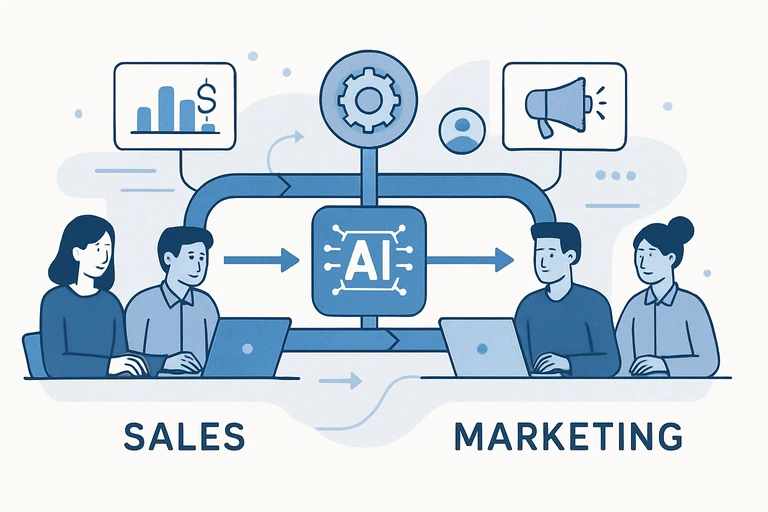
Intelligent workflows for sales and marketing teams unify data, align goals, and leverage AI-powered automation to accelerate revenue. This practical guide covers mapping current processes, setting joint objectives, automating high-impact tasks, ensuring data governance, and implementing a scalable architecture.
In today’s fast-moving markets, sales and marketing teams win when they work as one. Intelligent workflows bridge the gap between strategy and execution, turning scattered activities into a coordinated engine that accelerates revenue, improves customer experiences, and delivers measurable impact. This guide provides a practical, step-by-step approach to designing and implementing AI-powered workflows for do-it-now results.
Introduction: Why Intelligent Workflows Matter
Traditional handoffs between marketing and sales are often manual, fragmented, and siloed. Prospects fall through the cracks, messaging diverges across channels, and attribution becomes a guessing game. Intelligent workflows solve these problems by aligning goals, standardizing data, automating repetitive tasks, and using AI to prioritize actions that move deals forward.
The goal is not to replace people with machines, but to amplify human judgment with data-driven automation. When teams share a single source of truth and a common playbook, you can improve response times, personalize interactions at scale, and demonstrate tangible ROI to leadership.
Section 1: Start with a Clear Mapping of Your Current Workflows
Before you automate, you must understand what you currently do, where it breaks, and how it should work in an ideal world. Follow these steps:
- Document the end-to-end customer journey: identify stages from awareness to consideration, purchase, and post-sale advocacy. Map all touchpoints (ads, emails, calls, social interactions, events) and who owns each step.
- List bottlenecks and handoffs: note where leads stall, where data is re-entered, and where messaging is inconsistent.
- Audit your data model: ensure you have a shared schema for lead, contact, account, and opportunity, with consistent fields (source, stage, owner, last activity, consent status).
- Define SLAs between teams: set realistic response times for inbound inquiries, lead follow-ups, and proposal reviews. Make these visible to both sides.
- Identify quick wins: pick a few high-impact, low-complexity improvements (e.g., routing new MQLs to the right salesperson within 5 minutes).
Output a single source of truth: a unified CRM/marketing automation platform where data, events, and actions flow in a predictable, auditable way.
Section 2: Align Goals with a Unified Playbook
Sales and marketing must share objectives and measures of success. Use a framework that translates company strategy into concrete, measurable actions:
- OKRs (Objectives and Key Results): set quarterly goals for both teams (e.g., Increase MQL-to-SAL conversion by 20%, reduce average lead response time to under 10 minutes).
- Smarketing alignment: establish a joint backlog of campaigns and tactics, with clear ownership and shared KPIs.
- Lead qualification criteria: define what makes a lead Marketing Qualified (MQ) and what constitutes a SAL (Sales Accepted Lead), ensuring consistent scoring and routing rules.
- Attribution model: decide how you’ll attribute revenue to marketing activities (first touch, multi-touch, or a data-driven model) and bake it into dashboards.
Framework takeaway: a single source of truth, shared definitions, and agreed-upon metrics reduce ambiguity and accelerate decision-making.
Section 3: Automate with AI to Scale Impact
Automation is not just about sending more emails; it’s about delivering the right message at the right time and reducing manual work so teams can focus on higher-value activities. Consider these AI-powered capabilities:
- Lead scoring and routing: train models on historical win/loss data, account engagement, and intent signals to assign a dynamic score and route to the most suitable rep within minutes.
- Nurture and next-best-action campaigns: use AI to determine the next best content or touchpoint for each contact based on behavior, segment, and stage.
- AI-generated content suggestions: provide subject lines, email copy, and social posts tailored to buyer personas, increasing response rates while maintaining brand voice.
- Meeting scheduling and follow-ups: automate calendar availability checks, meeting invites, and post-meeting follow-ups to reduce no-show risk and speed deals forward.
- Personalization at scale: dynamically insert relevant case studies, ROI calculators, and pricing details based on industry, company size, and buyer role.
- Analytics-driven optimization: continuously test and refine campaigns, nudging budget allocation toward the most effective channels and messages.
Implementation tip: start small with a few high-leverage automations, measure impact, and scale incrementally to avoid overwhelming your team or your data quality.
Section 4: Data Quality, Governance, and Privacy
Automation relies on clean data. Establish governance practices to keep data accurate, complete, and compliant:
- Data standardization: enforce consistent field formats, deduplication rules, and validation checks at entry points.
- Consent and privacy: maintain explicit opt-in records, respect suppression lists, and implement data retention policies aligned with regulations (e.g., GDPR, CCPA).
- Data enrichment responsibly: use third-party enrichment sparingly, document the source, and verify critical data through multiple signals.
- Audit trails: log data changes, workflow decisions, and user actions for compliance and debugging.
Data governance is a foundation for trust. When teams trust the data, they trust the automation that depends on it.
Section 5: Tools, Architecture, and Data Flows
Choosing the right tools and designing a clean architecture are essential for scalable workflows. A practical reference architecture might include:
- CRM and Marketing Automation: the core systems for contact management, lead scoring, and campaign orchestration (e.g., Salesforce, HubSpot).
- Engagement platforms: multi-channel orchestration for email, phone, SMS, and social touches, with AI-enabled personalization.
- Data integration layer: an iPaaS or ETL/ELT layer to connect sources, unify data models, and move data reliably between systems.
- Analytics and BI: dashboards and reports that reveal attribution, pipeline velocity, and ROI by channel and persona.
- Security and governance: identity, access control, and data privacy controls embedded in every workflow.
Sample data flow (high level):
- Lead is captured from a form, ad, or event and seeded in the CRM with a baseline score.
- Marketing engagement (email opens, content downloads, site visits) updates the lead score and triggers an automated nurture path.
- Sales receives a SAL when AI predicts a high likelihood of close within a defined window; lead details are enriched and handed off with context.
- Campaigns are analyzed in a centralized dashboard to adjust budget and messaging in near real-time.
Implementation note: document your data contracts (what data is shared, where it lives, and how it’s used) and ensure your team has visibility into data lineage and access controls.
Section 6: An Implementation Blueprint You Can Start Today
Use this 6-step blueprint to move from concept to action with measurable outcomes:
- Audit and define: capture the current state, define target outcomes, and agree on shared metrics.
- Design the playbooks: create standardized sequences for common scenarios (e.g., inbound inquiry, MQL follow-up, ABM target account engagement).
- Choose minimal viable automations: pick 2–4 automations that address the largest pain points and offer the quickest wins.
- Implement with guardrails: configure data quality checks, role-based access, and escalation paths for failed automations.
- Measure everything: set dashboards for lead velocity, conversion rates, revenue influenced, and ROI per channel.
- Iterate and scale: optimize based on data, add new use-cases, and expand to new teams or regions gradually.
Practical tip: document success criteria for each automation so you can retire or adjust it if it stops delivering value.
Section 7: Real-World Scenarios and Measurable Outcomes
Below are two illustrative scenarios showing how intelligent workflows can move metrics meaningfully:
Scenario A: Inbound Marketing to Sales Acceleration
- Context: A software as a service company wants faster inbound response and higher MQL-to-SAL conversion.
- What was done: Implemented a 5-minute SLA for inbound inquiries, AI-driven lead routing to the best rep, and an email nurture sequence triggered by a high-intent score.
- Results (typical after 90 days):
- Lead response time reduced from 60 minutes to 6 minutes.
- Salable lead conversion rate improved by 22% month-over-month.
- Time-to-first-meeting shortened by 40% on qualified inquiries.
Scenario B: ABM Orchestration for Target Accounts
- Context: A B2B company targets top 100 accounts with personalized campaigns across email, web content, and sales outreach.
- What was done: Created account-based playbooks, unified data on key accounts, and used AI to tailor content and recommended next actions per account.
- Results:
- Pipeline velocity increased; average deal cycle shortened by 15–20 days for target accounts.
- Marketing-assisted revenue rose by 28% in the ABM segment.
Section 8: Pitfalls to Avoid and Best Practices
Even the best plan can fail if you overlook common missteps. Here are practical cautions and tips:
- Avoid over-automation: automate what truly adds value; keep humans in the loop for strategy, negotiation, and complex objections.
- Prevent data silos: ensure cross-team data synchronization and avoid duplicative systems that create conflicting insights.
- Prioritize data quality: bad data undermines AI results; invest in data cleansing and governance upfront.
- Start with quick wins: build confidence with early, measurable improvements before expanding scope.
- Validate privacy and compliance: align with regulations and obtain clear customer consent for marketing communications.
Best practice takeaway: pair people, processes, and technology in balanced measures—define the signal you want to optimize, then automate the rest.
Conclusion: Your Next Move Toward Revenue-Driven, AI-Powered Workflows
Intelligent workflows empower sales and marketing teams to move faster, talk to the right buyers, and make smarter decisions with data-driven confidence. By mapping current processes, aligning goals, deploying AI-enabled automation, safeguarding data quality, and following a disciplined implementation plan, you can unlock measurable improvements in response times, conversion rates, and revenue growth.
If you’re looking to tailor these ideas to your business, Multek is here to help you design and implement high-performance, AI-powered workflows that fit your unique context. We specialize in software solutions that accelerate time-to-value, maintain ethical data practices, and scale with your growth. Reach out to explore how a customized workflow strategy can transform your go-to-market engine.
Ready to Get Started?
Let’s turn intelligent workflows into tangible results. Contact Multek to discuss a tailored plan, proven playbooks, and the right mix of automation and human expertise for your sales and marketing teams.
You may also like

DevOps is within reach for SMEs. This practical guide outlines a lean, value-driven approach to auto...

Protecting APIs from leaks requires a defense-in-depth approach: strong authentication, fine-grained...