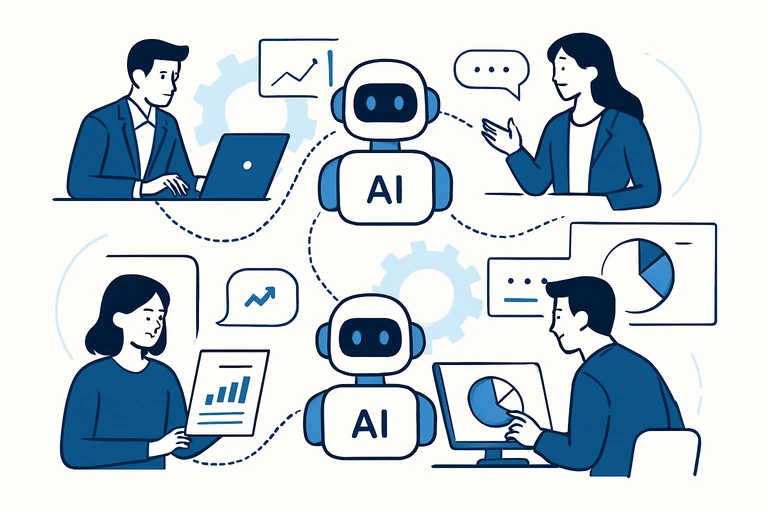
The Rise of Autonomous Agents in 2025 explores practical patterns, platforms, and governance conside...
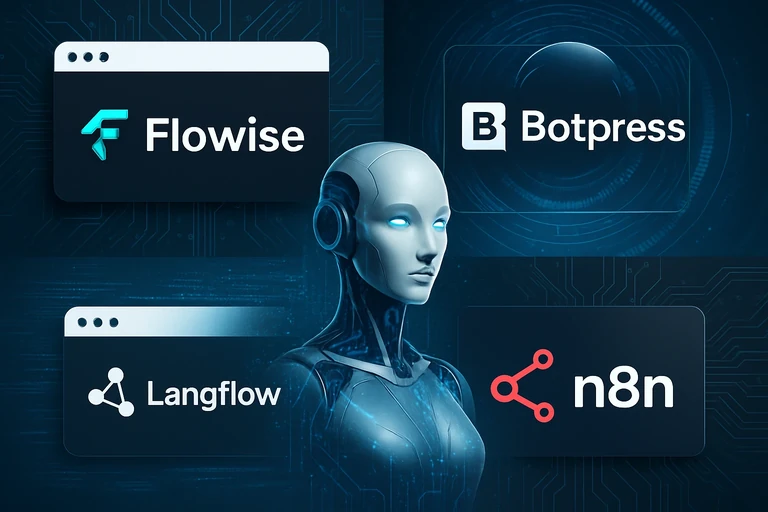
AI Agent Frameworks in 2025: Flowise, Botpress, Langflow, and n8n
A practical, production-focused overview of Flowise, Botpress, Langflow, and n8n in 2025, with guidance on choosing, architecting, and deploying AI agent frameworks for real-world use.
Introduction
2025 has solidified a new era of AI-powered automation: autonomous agents that can reason, plan, fetch data, and act across systems. For developers and product teams, choosing the right framework matters just as much as selecting a language model. This guide surveys four prominent AI agent frameworks shaping production today: Flowise, Botpress, Langflow, and n8n. Each brings a distinct blend of capabilities, deployment options, and ecosystems. Read on for a practical, implementation-oriented view to help you pick the right tool for your goals and constraints. As of August 2025, these frameworks are actively evolving; always check official docs for the latest features and releases.
What counts as an AI agent framework in 2025?
At a high level, AI agent frameworks provide building blocks to compose intelligent agents. They typically offer: - Visual or programmatic ways to assemble prompts, tools, memory, and data sources - Orchestration logic for multi-step reasoning, planning, and error handling - Integration points to connect to LLMs, vector stores, knowledge bases, and external APIs - Observability and control, including memory, logging, and human-in-the-loop options These capabilities enable teams to prototype rapidly and move to production with predictable, auditable behavior. The four frameworks below each emphasize different aspects of this space. Sources and context from vendor pages and industry analyses as of 2025.
Flowise: Open, modular, and LangChain-friendly AI flow design
Flowise is a fully open-source platform for building AI agents and LLM workflows through a drag-and-drop interface. It emphasizes visual design, rapid prototyping, and the ability to assemble complex flows without extensive coding. Flowise is distributed under an open-source license and offers a cloud option with tiered features for teams and enterprises. Core capabilities include a visual builder, multi-step flows, and tooling around memory, evaluation, and human-in-the-loop workflows. It also exposes APIs and a command-line interface for integration into larger pipelines. As of 2025, Flowise remains a strong choice for teams prioritizing openness, debuggability, and fast iteration.
- Open-source and self-hostable: Flowise is available for self-hosting, with cloud options for convenience. This aligns with teams seeking control over data and deployment environments.
- Visual builders for AI apps: It offers dedicated builders for assistants, chat flows, and agent orchestration, enabling both single-agent and multi-agent patterns.
- Tooling and evaluation: Built-in support for tracing, evaluations, and human-in-the-loop scenarios helps improve reliability in production.
Typical use cases include chatbot orchestration, RAG-enabled assistants, and multi-agent workflows that require deterministic control alongside AI reasoning. For teams already invested in LangChain or similar tool ecosystems, Flowise can be a natural entry point to model-driven workflows without heavy boilerplate. Note: some analyses position Flowise within the LangChain ecosystem for advanced workflows; verify current architecture in official docs for your environment.
Botpress: Enterprise-grade AI agent platform with memory and orchestration
Botpress presents itself as a complete AI agent platform designed for production at scale. It features an autonomous runtime (a custom inference engine named LLMz) that coordinates agent behavior, memory, tool usage, and structured outputs. Botpress emphasizes deep observability, security, multilingual capabilities, and extensibility through custom code injections and API access. It’s positioned as a robust option for teams building customer support, enterprise knowledge apps, or multi-channel agents that require strong governance and reliability. As of 2025, Botpress continues to highlight production readiness and a strong developer experience.
- Self-contained agent runtime: Each deployed agent runs in its own isolated environment with versioning and durability guarantees, helping maintain compatibility over time.
- Memory and state handling: Stateful conversations enable agents to retain context across steps, improving coherence in long-running interactions.
- Extensibility and API access: Developers can inject custom code, inspect agent actions, and access necessary APIs to integrate with existing systems.
Botpress is well-suited for complex, enterprise-grade customer interactions where governance, compliance, and multi-channel delivery are essential. It also benefits organizations seeking a mature ecosystem with analytics, translation, and channel integrations. Recent messaging around Botpress emphasizes scalable deployment and robust tooling for production agents.
Langflow: Visual LangChain UI for rapid prototyping and agent orchestration
Langflow is an open-source GUI for LangChain that makes it easier to prototype LLM-based applications, including agents and MCP (Model Context Protocol)–driven flows. It provides a visual editor to connect components such as LLMs, prompts, memory, tools, and data sources, and supports running flows locally or deploying them as MCP servers. Langflow is widely used by teams that want a no- or low-code path to LangChain-powered apps while retaining access to Python under the hood for advanced customization. As of 2025, Langflow remains a popular open-source option for LangChain-based experimentation and early-stage production prototypes.
- Open-source and LangChain-centric: Langflow focuses on LangChain components and flows, with agent and MCP support built in.
- Drag-and-drop prototyping: The visual editor accelerates exploration of chains, agents, and tool usage, reducing boilerplate.
- Real-time testing and deployment options: Langflow supports testing in a Playground and serving flows via an API for integration into apps.
Langflow is particularly compelling for teams that want to iterate quickly on LangChain-driven designs, experiment with different memory models or tool inventories, and ultimately ship flows that can be deployed as microservices or MCP servers. Official docs and the project site offer extensive guidance on getting started and deploying in production contexts.
n8n: Multi-agent orchestration and AI-enabled automation
n8n is best known as a general workflow automation platform with strong open-source roots and a growing focus on AI-enabled capabilities. It excels in composing agentic workflows that coordinate multiple agents and tools, with built-in memory options, pre-built LangChain nodes, and robust deployment options (self-hosted or cloud). In 2025, n8n emphasizes multi-agent systems, planning agents, RAG-enabled workflows, and human-in-the-loop guardrails—critical for production reliability when AI agents perform non-trivial tasks. As of 2025, n8n remains a leading choice for teams seeking production-grade automation with AI integration, including open-source flexibility and SOC 2–level controls.
- Multi-Agent systems and planning: Orchestrate several specialized agents to tackle complex tasks, with clear handoffs between agents.
- Memory and tools: Built-in memory options and a wide set of nodes (e.g., LangChain nodes, HTTP, databases) enable sustained context and diverse capabilities.
- Open-source with enterprise options: Self-hosted deployment is available, and SOC 2–compliant deployments are highlighted for production use.
n8n is particularly attractive for teams that need to connect AI models to a broad set of enterprise systems, or for those who want to blend deterministic automation with AI reasoning in a single, auditable workflow. The platform’s ecosystem and community templates also speed up early experimentation.
How to choose among Flowise, Botpress, Langflow, and n8n in 2025
The best choice depends on your objectives, data governance needs, and team skillset. Here are practical decision criteria to guide selection:
- Production-readiness and governance: If you require robust observability, security, and enterprise-grade deployment, Botpress and n8n offer strong pathways, with Botpress focusing on agent orchestration and n8n emphasizing end-to-end automation. Flowise and Langflow are excellent for rapid prototyping and LangChain-centric workflows.
- Openness and vendor lock-in: Flowise and Langflow are open-source and community-driven, which benefits transparency and customization. Botpress and n8n also offer open-source options, with commercial deployments available.
- Data locality and hosting: If data locality and on-prem hosting matter, all four frameworks offer self-hosted capabilities, but verify your compliance, memory management, and data retention features in each project’s docs.
- Ease of use and iteration speed: Langflow and Flowise shine for rapid prototyping with visual editors, while Botpress and n8n offer broader production tooling and integration ecosystems.
Bottom line: for a small-to-mid-size team prioritizing speed and low-code development, Langflow or Flowise are excellent starting points. For production-grade agents with strong governance, Botpress or n8n can provide more mature enterprise features and integrations. In practice, many teams adopt a hybrid approach, using a visual designer for rapid prototyping and a separate automation/orchestration layer for production workflows.
A practical pattern: building an AI-powered knowledge assistant (step-by-step)
Below are two concrete paths you can adapt depending on your chosen framework. Both patterns aim to deliver reliable, up-to-date answers by combining LLM reasoning with data retrieval and a controlled workflow.
Pattern A — Flowise-based agent with memory and RAG
- Define objective and data sources: Determine the user need (e.g., answering product questions using internal docs and live data). Identify document stores, APIs, and any live data feeds.
- Set up Flowise: Install Flowise and create an Agentflow (or equivalent) to orchestrate prompts, tools, and memory.
- Configure LLMs and tools: Add an LLM (e.g., OpenAI or an alternative) and connect tools such as a document retriever, a web search tool, or a custom API to fetch live data.
- Enable memory and context persistence: Use Flowise memory components to retain user context across turns, enabling coherent follow-ups.
- Incorporate retrieval augmentation: Add a RAG flow to fetch relevant docs from a knowledge base before prompting the LLM, ensuring grounded responses.
- Observability and testing: Use Flowise’ tracing and evaluation features to test prompts, monitor outputs, and refine prompts and tool usage.
- Deployment: Deploy as an API service or embed in a web chat widget; configure authentication and logging for production.
This pattern emphasizes rapid prototyping with a clear path to production, thanks to Flowise’ open and visual nature combined with dedicated agent tooling.
Pattern B — Langflow-led knowledge assistant with MCP and agents
- Define the agent architecture: Decide whether you’ll use a single agent with memory or a multi-agent setup that delegates tasks (e.g., research agent, QA agent, and summarization agent).
- Build flows with Langflow: Use Langflow to wire together LLMs, memory, prompts, tools, and data sources. Leverage MCP capabilities to expose flows as services or to connect to external apps.
- Add tools and data sources: Connect to your internal APIs, databases, and document stores. Include a retrieval step to fetch relevant information for grounding responses.
- Test in real-time: Use Langflow’s Playground and testing features to iterate on prompts, tool usage, and flow structure.
- Deploy and monitor: Serve the flow as an API or a fleet of agents; implement monitoring, logging, and alerting to detect drift or failures.
Langflow’s strength is fast prototyping with a LangChain-centric model, which suits teams already invested in LangChain components and Python-based tooling.
Security, privacy, and governance considerations for 2025 deployments
As you move into production, remember that the guarantees you need around data privacy, access control, and auditability will drive choices about hosting (cloud vs. on-prem), model selection, and logging. Key considerations include: - Data locality and encryption in transit/rest - Access controls and role-based permissions for agents and workflows - Observability: structured logs, tracing, and alerting for prompt quality and tool failures - Human-in-the-loop gates for high-stakes decisions - Compliance with applicable regulations (e.g., privacy laws and industry standards) - Ability to update or rollback prompts and tool configurations safely All four platforms discussed here provide paths to self-hosted or enterprise deployments, which can help address these concerns.
Implementation quick-start: getting started with each framework
Roadmap and trends to watch in 2025 and beyond
Several developments are shaping the AI agent landscape this year: - Multi-agent orchestration and planning: Teams increasingly deploy teams of agents to tackle complex tasks with clear handoffs. - Memory and state management: Agent memory improves continuity across long sessions and reduces repetitive prompts. - Retrieval-augmented generation (RAG): Access to live data and knowledge bases remains a cornerstone for accuracy and grounding. - Observability and governance: Production-ready tools emphasize tracing, evaluation, and human-in-the-loop controls to manage risk.
Conclusion
By mid-2025, Flowise, Botpress, Langflow, and n8n each offer compelling paths to building AI agents, with distinct strengths in openness, production readiness, and ease of prototyping. For teams prioritizing rapid iteration and no-vendor-lock-in, Flowise and Langflow are excellent starting points. For organizations needing mature governance, observability, and enterprise-grade capabilities, Botpress and n8n provide robust foundations and strong integration capabilities. The most effective strategy is often a hybrid: use a visual designer for rapid prototyping and a production-oriented automation/orchestration layer to ensure reliability and governance at scale. If you’re exploring these options for a real-world project, consider a small pilot to validate data handling, latency, and user experience before committing to a larger deployment. And as always, Multek stands ready to help you assess, design, and implement AI agent architectures that deliver measurable value while upholding security, privacy, and sustainability.
You may also like
DevOps is within reach for SMEs. This practical guide outlines a lean, value-driven approach to auto...

Deepfakes and AI-driven deception pose real risks to businesses, from executive impersonation to bra...